Security Risk & Compliance
The NIS 2 Directive (2022/2555) is the EU’s updated cybersecurity law, replacing the original NIS Directive. It sets a higher baseline for security across critical and important sectors to better protect against growing cyber threats.
Key changes include:
Struggling to understand how the NIS2 Directive applies to your small or medium-sized enterprise? Designed specifically for SMEs, this guide simplifies the core aspects of NIS2 compliance by translating regulatory requirements into clear, actionable steps across risk management, security controls and reporting duties.
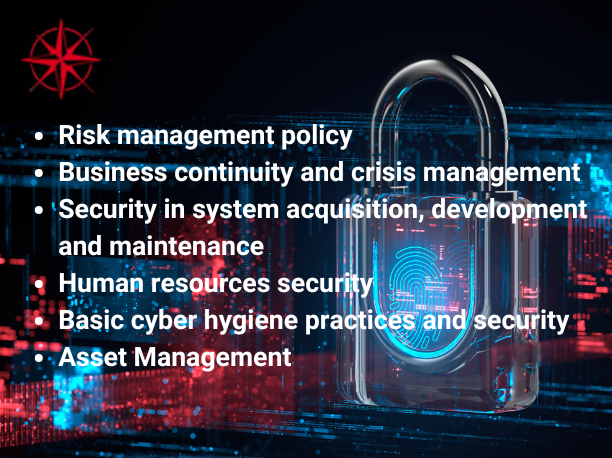
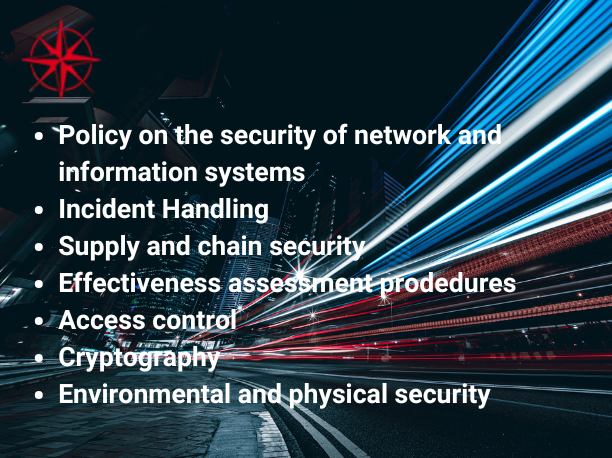
The NIS 2 Directive significantly updates the EU’s cybersecurity framework to address modern threats and expand its coverage. Key changes include:
If your business provides digital or essential services to customers in the EU—whether you’re based in the US, UK, or elsewhere—you must comply with NIS 2. This includes appointing an EU representative, securing your systems, and reporting incidents to EU authorities. Fines and enforcement still apply, even if your headquarters are outside Europe.
Here are the Top 5 Risk Areas:
1. Weak cybersecurity controls
2. Late or missing incident reports
3. No board-level accountability
4. Uncontrolled supply chain risks
5. Lack of testing and training
Each one can lead to major penalties, including fines up to €10 million or 2% of your annual global turnover.
Organizations certified to ISO/IEC 27001 are already well-positioned for NIS 2 compliance. The two frameworks share core principles around risk management, information security controls, and continuous improvement. However, NIS 2 introduces additional legal, operational, and reporting obligations that go beyond the ISO standard.
A significant incident is one that could cause major disruption, financial loss, or impact public trust—especially across multiple EU countries. Each Member State defines specific thresholds you should look for. If any of these thresholds are met, you must report it fast:
All reports go to your national CSIRT and competent authority. Look out for national variances in reporting deadlines
A significant incident is one that could cause major disruption, financial loss, or impact public trust—especially across multiple EU countries. Each Member State defines specific thresholds you should look for. If any of these thresholds are met, you must report it fast:
All reports go to your national CSIRT and competent authority. Look out for national variances in reporting deadlines
Based on the State of the Digital Decade 2025 report, only 35.5% of the enterprises had documentation on measures, practices or procedures on ICT security, and only 34.1% of them had carried out an ICT risk assessment. According to Eurostat, in 2024, 21.5% of enterprises experienced ICT-related security incidents leading to some adverse consequences.
Organisations falling within the scope of NIS 2—especially those newly designated as essential or important entities—should begin preparations without delay.
Key next steps include:
Familiarise the organisation with NIS 2’s legal, technical, and governance requirements.
Determine how existing cybersecurity, risk management, and compliance practices align with NIS 2 obligations.
Raise awareness at board and executive level. NIS 2 introduces management-level accountability, including personal liability for governance failures.
Try our free NIS 2 readiness assessment and access a step-by-step compliance checklist.
These free guide help identify your organisation’s current state and the key actions needed to meet the Directive’s requirements.
Quadprime, drawing upon its extensive knowledge and experience, is at the forefront of assisting organizations in achieving NIS 2 compliance. Recognizing the unique risk profiles of critical infrastructure and other essential entities we have been working with since the first NIS Directive came into force, we offer bespoke advisory, training and technical services to navigate the intricacies of the NIS 2 requirement and ensure organisations in scope achieve the required level of compliance. At QuadPrime, we have supported organizations in critical sectors since the first NIS Directive. Today, we bring that expertise to companies of all sizes, including SMEs, with a tailored and cost-effective approach to NIS 2 compliance. Our services have been sought by the most critical infrastructure and essential services providers and our experts have been working on every aspect of NIS compliance, namely governance, risk, technical and organisational measures, audits producing efficiencies and upgrading consistently the security posture of our clients.
Whether you are evolving from NIS 1 or preparing for NIS 2 for the first time,
our services are built to support your entire compliance journey.
Our end-to-end compliance services are designed as a one-stop shop to support entities at every stage of their NIS 2 journey. Whether you’re adapting existing frameworks or building new capabilities, we provide a well-rounded mix of governance, risk, protection, training, and auditing services. This integrated approach simplifies compliance, reduces operational strain, and ensures your organisation meets regulatory expectations with confidence.
Integrate NIS 2 requirements into existing risk and governance frameworks. We align Article 21 obligations with enterprise risk processes, ensuring cybersecurity is embedded in board reporting, strategic decisions, and operational planning.
Compare existing controls (e.g. ISO/IEC 27001) against NIS 2 requirements.
We map ISO 27001 controls directly to NIS 2 obligations, conduct a focused gap analysis, and implement only what’s missing—ensuring a fast, cost-effective, and fatigue-free path to compliance.
Develop or update cybersecurity policies, procedures, and plans to comply with Article 21 of NIS2. We cover incident response, access control, business continuity, supply chain security, and more—ensuring both practical value and regulatory alignment.
Design and run tests (vulnerability scanning, penetration testing) and scenario based table-top or live exercises. Provide structured test plans, help to track findings, and verify that remedial actions close gaps—demonstrating operational resilience.
Establish structured workflows for detecting, escalating, and reporting significant incidents. We align processes with the 24-hour, 72-hour, and 1-month reporting windows, and simulate scenarios to test coordination with CSIRTs and regulators.
Assess and manage cybersecurity risks arising from third-party vendors and suppliers.We help implement due diligence frameworks, third party risk modelling, contract clauses, and assurance mechanisms to maintain control over external dependencies.
Educate executive leadership and key staff on their responsibilities under NIS 2.
We deliver tailored briefings and workshops covering regulatory obligations, Risk Management, incident response and business continuity —building organisational readiness.
Prepare structured, defensible documentation to demonstrate compliance.
This includes control evidence, governance artefacts, and incident records—designed to meet regulator expectations and withstand external scrutiny.
Conduct internal audits to verify NIS 2 readiness and support cybersecurity maturity. Our reviews identify control gaps, assess effectiveness, and prepare entities for formal inspections or supervisory audits.
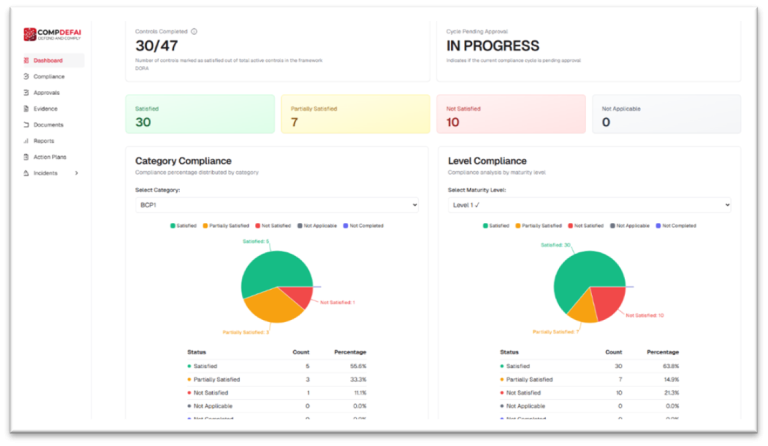
Traditional compliance methods based on spreadsheets are no longer enough. That’s why we created COMPDEFAI a dedicated software tool built specifically for NIS 2 compliance.
With COMPDEFAI you can:
• Track compliance across all NIS 2 domains
• Identify and close gaps with the legislation
• Generate reports for auditors and the National Authorities
• Empower your team with clear dashboards and action plans
Ready to Start?
Whether you’re just getting started or need help progressing your compliance, QuadPrime is here to support you. Our team of experts are available to guide you through the entire process from assessment to reporting.
Contact us today to schedule your NIS 2 readiness session. Let’s make compliance simple and get you ahead of the deadline.