
Welcome to our UK site – choose your Jurisdiction

Compliance Monitoring & Learning Solution

Simplify Your Compliance Management & Training

Training Courses

This module provides an overview of the individual Conduct Rules introduced by the Financial Conduct Authority (FCA) and the Prudential Regulation Authority (PRA) – the UK’s financial services regulators – which initially came into effect progressively between 2016 and 2021.

In July 2022, the Financial Conduct Authority, or FCA, published a policy statement, with final rules, on its Consumer Duty initiative. This comprises a new principle, cross-cutting rules, and four outcomes for retail consumers. The Consumer Duty will mean that consumers should receive communications they can understand products and services that meet their needs and offer fair value, and obtain the customer support they need, when they need it.
Fraud is usually defined by domestic regulators as taking place within a ‘given industry’ and within the broader legal framework, in a ‘given country’. Unethical behaviour is closely related and may be forbidden by industry or law firm associations, accounting organisations, or other private professional groups.
This course outlines the need for combating ML risks and other financial crimes. Financial institutions must be able to respond to threads on a contextual basis to balance efficiency and cost needs with compliance obligations.
This course outlines provides a brief overview of Suspicious Transactions / Activity Reporting process in a regulated financial services firm.
This course outlines basic CDD procedures requires to assess customer risk and a legal requirement to comply with Anti-Money Laundering (AML) and Counter-Terrorist Financing (CFT) laws. Effective CDD involves ongoing monitoring of customers’ business activities, identifying and mitigating the AML/CFT risk a business relationship may pose to a regulated entity.
IT Security is one of the most sought-after subjects due to the constant development of new technologies and the increasing number of cyber threats. Gain essential IT security knowledge and skills, to help protect your digital life.
This course provides staff with an understanding of Conflict of Interest, the laws and regulations that make it illegal, and the responsibilities of employees to help detect and prevent it.
Anti-bribery and anti-corruption legislation globally has existed for some time, though enforcement is becoming more aggressive. There is heightened regulatory focus on how insurers obtain and retain business within emerging markets where bribery and corruption is prolific.
Approved Persons Regime awareness course for all members of firms NOT subject to the Senior Managers & Certification Regime (SM&CR) which came into effect on 7 March 2016, applying to banks, building societies, credit unions and investment firms that are subject to dual regulation by the Prudential Regulation Authority (PRA) and Financial Conduct Authority (FCA). Please note that, if your firm is currently regulated solely by the FCA under the Approved Persons Regime, this will be replaced by SM&CR in 2019 (or December 2018 for insurers).

Compliance involves the efforts and programs of an organization to ensure that the business complies with government and industry regulations. If your organization is subject to a compliance scheme, it means your business is bound, by contract or law, to follow rules set by external bodies.

An online e-learning primer aimed as an introductory overview for those working in FCA-regulated firms to enable them to understand the Conduct Rules within the Senior Managers and Certification Regime, and make them aware of the requirements of the FCA.
This Treating Customers Fairly (“TCF”) course for all members of a firm helps them show the FCA that fair treatment of customers is at the heart of their business model.
The course provides understanding of the regulatory drivers and priorities; considers the factors you should promote to build and embed an inclusive operational resilience framework; enables you to recognise common risks and disruptors to operational stability and consider appropriate governance models.
This course is designed to give all employees of a firm an understanding of what GDPR is intended to achieve, how it aims to empower individuals, and how it impacts firms and the roles of their employees.
This course explores what to consider when building a compliant Compliance Monitoring programme and how to effectively deliver reports.It considers the FCA’s requirements and expectations around the monitoring and testing undertaken by UK authorised firms.
Risk assessment enables financial institutions to focus on their AML/CFT efforts and adopt appropriate measures to allocate the necessary resources in an optimal way. Based on the assessments conducted, the financial institutions should have controls, policies, and procedures that allow them to effectively manage and mitigate the risks identified.

This module provides an overview of the individual Conduct Rules introduced by the Financial Conduct Authority (FCA) and the Prudential Regulation Authority (PRA) – the UK’s financial services regulators – which initially came into effect progressively between 2016 and 2021.

In July 2022, the Financial Conduct Authority, or FCA, published a policy statement, with final rules, on its Consumer Duty initiative. This comprises a new principle, cross-cutting rules, and four outcomes for retail consumers. The Consumer Duty will mean that consumers should receive communications they can understand products and services that meet their needs and offer fair value, and obtain the customer support they need, when they need it.

The risk-based approach (RBA) is central to the effective implementation of the Financial Action Task Force (FATF) recommendations. This means that supervisors, financial institutions, and intermediaries should be able to identify, assess, and understand the risks related to money laundering and terrorist financing to which they are exposed, and implement the most appropriate mitigation measures.

This course outlines the need for combating ML risks and other financial crimes. Financial institutions must be able to respond to threads on a contextual basis to balance efficiency and cost needs with compliance obligations.

KYC/CDD is a critical element for effectively managing the risks posed by potential clients thus protecting the organization against criminals, terrorists, and Politically Exposed Persons (PEPs) who might present a higher risk, and possible dubious actions by existing customers that need to be regularly reassessed. This course provides an introduction to KYC and CDD procedures, both key tools in assessing customer risk and a legal requirement to comply with Anti-Money Laundering (AML) and Counter-Terrorist Financing (CFT) laws.

This course outlines basic CDD procedures requires to assess customer risk and a legal requirement to comply with Anti-Money Laundering (AML) and Counter-Terrorist Financing (CFT) laws. Effective CDD involves ongoing monitoring of customers’ business activities, identifying and mitigating the AML/CFT risk a business relationship may pose to a regulated entity.

This course provides staff with an understanding of the process of money laundering, the laws and regulations that make it illegal, and the responsibilities of employees to help detect and prevent it.
A short online e-learning primer for those working in financial services firms explaining the rules on whistleblowing and when it may be appropriate to make a disclosure (‘blow the whistle’), if a firm or individual is involved in wrongdoing.
Market abuse may arise in circumstances where financial market investors have been unreasonably disadvantaged, directly or indirectly, by others who: have used information which is not publicly available.
An online e-learning course aimed as an introductory overview for those working in FCA authorised firms to enable them to understand the Senior Managers and Certification Regime and make them aware of the requirements of the FCA.
This self-paced online course provides an overview of AML, the measures needed for efficient AML controls, Suspicious Transaction Monitoring, and Suspicious Activity Reporting (SAR) to help learners understand their obligations to report suspicious activity, when to report suspicious activity, and how to report better quality SARs.
Given its role and importance to any functioning modern economy, ‘trust’ is an essential ingredient between providers of financial services, its clients and even wider society. Culture, conduct and ethics are words which have come to pepper the regulatory lexicon. The importance of these intangible concepts and “getting it right” has been clearly communicated, and myriad speeches and initiatives in the financial services sector focus on these themes.
This module provides an overview of the individual Conduct Rules introduced by the Financial Conduct Authority (FCA) and the Prudential Regulation Authority (PRA) – the UK’s financial services regulators – which initially came into effect progressively between 2016 and 2021.
This course looks at the key rules and requirements to issue complaint financial promotions and maintain appropriate oversight and control of your financial promotion process.
This course seeks to explain the role the FCA plays in the financial services sector and its position within the overall UK economy. We look at the structure of the regulator and how it is designed to support the objectives allocated to it.
The ICARA Process requirement is deriving from the provisions of the new prudential package (Investment Firms Regulation and Directive) introduced by the European Commission. The aim of this course is to provide a comprehensive understanding of the ICARA process methodologies and requirements, as well as its implications for Investment Firms operating within the European Union.
The aim of this self-paced eLearning course is to equip financial professionals, leaders, and compliance professionals with a comprehensive understanding of compliance culture in financial services.

Compliance Training

Your compliance training needs are covered by the

Compliance Learning Solution (CLS).

Comprehensive online training courses in governance, risk and compliance for the financial services sector and more.

Regulatory Compliance Management Solution

A user-friendly compliance monitoring and workflow tool that facilitates meeting your regulatory obligations.

CMLS improves your organisation’s operational resilience by providing a single source for all compliance-related activities and streamlining the reporting process.

ComplyPortal’s Regulatory Compliance Management Solution

Built by Compliance experts, ComplyPortal’s main features & advantages include:

Ready-to-Use Monitoring Templates

Powerful Workflow Automation

Access from Any Device

Flexible Configuration Options for Bespoke Needs

Reports & Audit Trail Logs

Scheduled Notifications & Reminders for Your Team

ComplyPortal Includes a Standard Core Suite of Modules Covering:

Monitoring

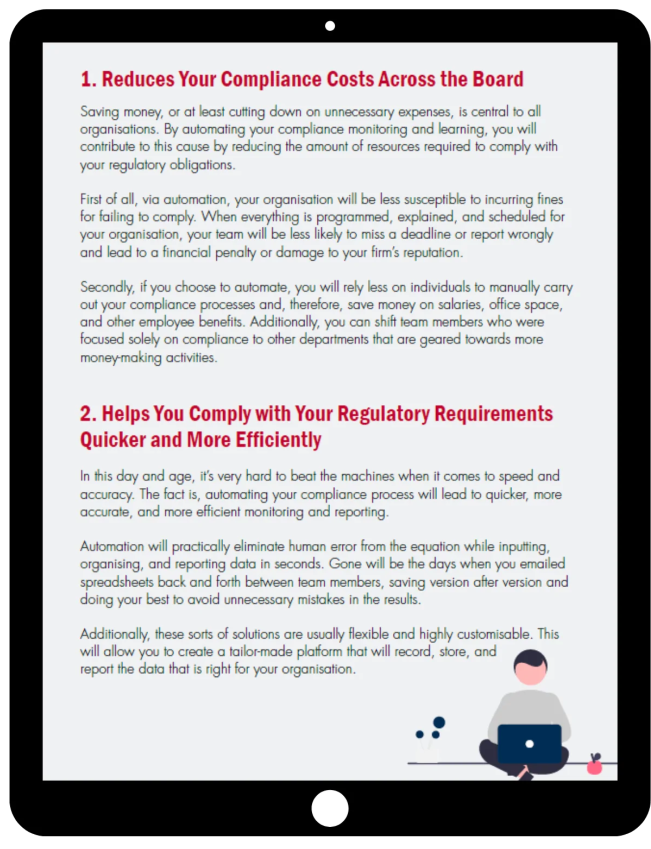
Digitise your compliance monitoring program, be audit ready, and reduce the burden associated with typical spreadsheet driven processes.

Approvals

Ready to use workflows for submitting, routing, tracking and reporting on requests for approvals.

Attestations

Easily request, schedule and collect acknowledgements from staff on important documents, policies and/or procedures.

Documents

Share important documents securely based on permissions. Collect attestations on each version, use it for meeting minutes, to review policies and more.

Prompts

Our team of seasoned professionals, including former regulators and industry experts, leads all engagements, offering deep insights and practical advice to help you manage compliance risks effectively.

Registers

Secure access to important information on a need-to-know basis. Silo registers and access according to permissions.

Navigating the Path to Regulatory Maturity

COMPDEFAI is a robust Governance, Risk and Compliance (GRC) software solution developed by industry-leading cybersecurity and audit specialists. It is designed specifically to help regulated financial institutions and essential service providers streamline their compliance journey, ensuring digital operational resilience and long-term security.

Our end-to-end platform simplifies the complexities of regulation, reducing risk, saving valuable time and ensuring total alignment with the two most demanding EU regulatory frameworks: NIS2 and DORA.


Download Our Compliance Monitoring & Learning Solution White Paper

Fill out your details below to download our white paper and learn about seven benefits of adopting our compliance monitoring and learning solution.

Compliance Learning Solution (CLS)

Our state-of-the-art CLS provides an easy and user-friendly way to deliver, manage, and track all of your training needs in collaboration with The London Governance & Compliance Academy (LGCA). You will be able to access robust reporting, integrate human resources data, and even enable single sign-on. Plus, you’ll always have one-click access to your governance, risk and compliance (GRC) e-learning courses.

LGCA’s Solution Has Been Created to Facilitate & Monitor Required Compliance eLearning Courses

Ready-Made Course Libraries

LGCA’s FCA, EU, and global regulatory compliance libraries deliver GRC training across key areas such as AML, anti-bribery and corruption, fraud, risk management, data protection, market abuse, international economic sanctions, KYC and CDD, and treating customers fairly, among a host of others. These courses are ready to be used and can be uploaded onto your organisation’s SCORM-supported LMS within 48 hours.

Expert Content

All of LGCA’s content has been prepared by subject matter experts who are actively involved in the financial markets as academics, consultants, lawyers, or service providers. These experts work alongside LGCA’s educational design team to develop courses that are up-to-date, deliver the knowledge and skills required by both clients and regulators, and adapt themselves well to adult learners and their different learning styles. Additionally, all of this content is fully customisable. For instance, you can incorporate slides of your own and edit the standard text to better suit your needs. LGCA believes being flexible will help you offer a stronger, more valuable, and concise learning experience to your team members.

How Complyport Compares

Complyport
Others
Easier Approvals
Same Day Subject Matter Expert Assigned to you
Faster Approach
96% Probability of Approval

Get In Touch